
The Future of International Health Insurance Protection: 10 Strategic Take Aways from the 2026 iPMI Technology Round Table
- Written by: iPMI Global
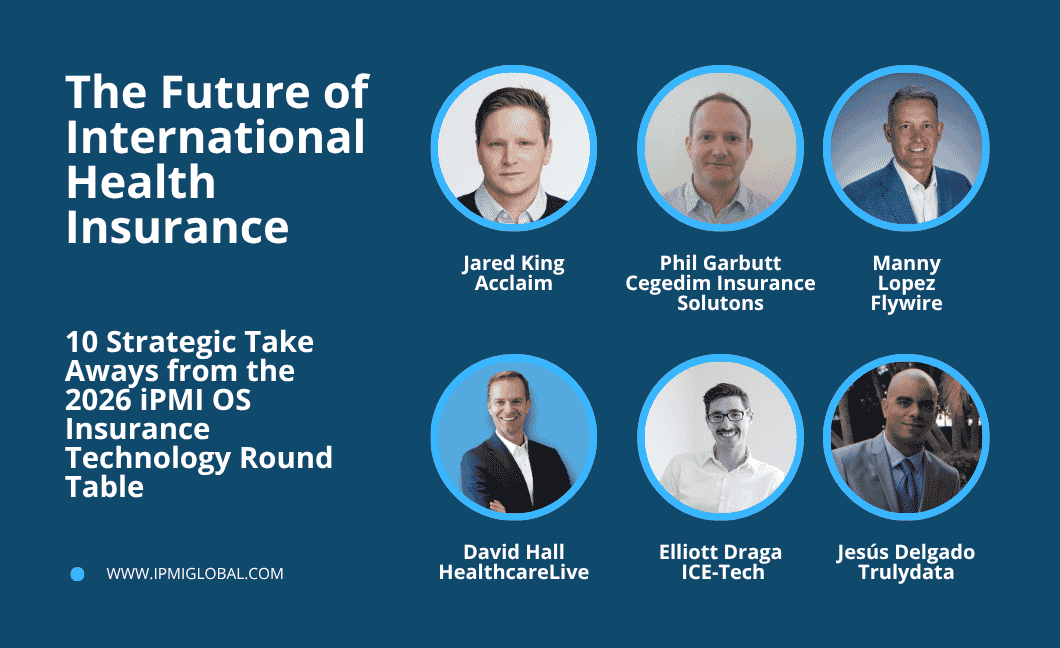
2026 is a massive turning point for the international private medical insurance (iPMI) industry. The days of just "experimenting" with digital tech are officially over. Instead, companies are being hit from all sides by a perfect storm: technology legacy debt, a brutal 10% to 12% spike in global medical inflation, and strict new rules from the EU AI Act. To survive, the old ways of doing things simply won't cut it anymore.
This report brings together the frontline insights of six industry heavyweights—Acclaim, Cegedim Insurance Solutions, Flywire, HealthcareLive, ICE-Tech, and Trulydata. These companies essentially run the back-end plumbing of global healthcare. (To put their scale into perspective, Cegedim alone processes around €5 billion in health claims every year).
Their collective takeaway is crystal clear: in 2026, you don't win by hoarding your data in isolated silos. Winning means having the flexible, modern tech architecture needed to manage complex, global data instantly.
But dealing with this change doesn't mean tearing everything down. The smart move right now is focusing on modernization strategies that fix the foundations while actively lowering risk, rather than blowing up core systems and starting from scratch.
Takeaway 1: The Victory of "Wrap and Extend" Over "Rip and Replace"
In an era defined by high operational risk, the "rip and replace" model of core-system migration has largely been discarded in favour of more surgical interventions. The strategic consensus among experts from Acclaim and Flywire is that full core migrations are often multi-year liabilities that fail to deliver immediate ROI. Instead, the "wrap and extend" strategy has emerged as the pragmatic path forward. By layering intelligent API-based services and modern financial orchestration over existing systems of record, insurers can deliver modern member experiences without the systemic shock of a total overhaul.
However, Cegedim and ICE-Tech identify specific triggers where replacement remains an economic imperative: legacy systems characterized by closed integrations, undocumented logic, or a fundamental inability to support the data transparency required by modern regulators. The goal is a phased modernization that treats the core system as a deterministic source of truth while leveraging external intelligent layers to drive rapid value creation.
This architectural shift, however, creates a new challenge: the potential for a fragmented ecosystem to impose a hidden financial burden on the operation.
Takeaway 2: Eradicating the "Integration Tax" Through Best-of-Breed Openness
The "integration tax"—the excessive capital and time spent forcing disparate systems to communicate—is now recognized as the primary barrier to market agility, frequently stretching product launch timelines from weeks to months. The industry is moving away from monolithic suites toward "best-of-breed" ecosystems built on an API-first philosophy. ICE-Tech’s emphasis on no-code launches and Flywire’s "Integration Studio" illustrate how insurers are reclaiming control from IT bottlenecks by allowing finance and operations teams to own their workflows.
Yet, a best-of-breed strategy without central orchestration risks creating "worst-of-breed" fragmentation. Phil Garbutt of Cegedim Insurance Solutions highlights the strategic risk of point-solution proliferation:
"The integration tax is real and growing... Every new capability—extraction, translation, fraud detection—arrives as a separate point solution with its own UI and data model. Left unmanaged, the claims handler ends up as the human integration layer, switching between half a dozen tools to process a single claim. That isn’t best-of-breed; it’s worst-of-breed."
To survive this, insurers must prioritize "agent-friendly" interfaces and standardized data contracts that allow for the seamless swapping of AI capabilities without triggering major infrastructure projects. This orchestration is not just an operational preference; it is a regulatory necessity.
Takeaway 3: The Architecture of Accountability—Meeting the EU AI Act Head-On
With the EU AI Act now enforceable, the "Right to Explanation" has transformed from a theoretical preference into a core architectural requirement. Platforms must now embed auditability into their foundations to satisfy regulators that automated decisions are transparent. ICE-Tech’s "Alice" framework and Cegedim’s "Right model, right task" principle reflect a shift toward governed AI, where deterministic rules manage binary outcomes and probabilistic AI is reserved for unstructured clinical narratives.
To satisfy global auditors, the panel identified essential "audit trail" components that must be present in any modern system. According to Acclaim and Trulydata, these requirements include:
- Decision Path Reconstruction (Acclaim): The ability for an insurer to reconstruct the exact logic path and inputs for any automated payment or routing decision.
- Retention of Underlying Criteria (Trulydata): The persistent storage of the specific business rules and criteria active at the moment of execution.
- Timestamped Operational Logs: A chronological record of every automated action and human intervention.
- Traceability of Extraction: Linking every AI-extracted data point back to its specific coordinate in the original source document.
As these governed systems become more robust, they finally unlock the potential for a member journey that feels entirely frictionless.
Takeaway 4: Solving the "Intake Problem" to Unlock Invisible Insurance
"Invisible Insurance"—where the member never files a claim or pays out-of-pocket—is the strategic North Star for 2026. The primary hurdle to this vision is the "intake problem." Cegedim argues that the industry has historically engaged in systematic "data destruction," discarding approximately 50% of document context through manual rekeying. By distilling rich clinical narratives into a few structured database fields, insurers "thin the slice" of data available for downstream fraud detection and analytics.
True frictionless healthcare requires AI extraction that preserves the clinical narrative, treatment domain, and provider relationships in their entirety. HealthcareLive and Acclaim emphasize that front-end digital "veneer" is insufficient if the backend remains fragmented; interoperability—not just a pretty app—is the engine of invisible service.
Failing to solve this intake friction directly impacts the bottom line, particularly as medical costs continue to climb globally.
Takeaway 5: Operational Efficiency as the Primary Defence Against 10–12% Inflation
With global medical inflation sustained at 10–12%, technology has shifted from a tool for growth to a defensive necessity. Insurers are now leveraging operational efficiency to recover margin directly from the combined ratio.
Strategic "care navigation" further reduces exposure by guiding members toward appropriate care levels before high-cost claims are even generated. However, operational efficiency is moot if it cannot be replicated across the jurisdictional complexity of the global nomad.
Takeaway 6: Decoupling Global Logic from Local Realities in a Three-Country Scenario
The modern iPMI member creates a complex "three-country scenario": living in Country A, insured in Country B, and receiving treatment in Country C. To manage this, systems must technically decouple "global" elements (the policy and claims record) from "local" variables (currencies, tax, and coding systems like ICD/CPT).
Platforms like Cegedim’s Actisure maintain a single source of truth for the policy record while configuring local layers for regional compliance. Flywire and Acclaim further simplify this by abstracting FX risk and settlement mechanics. In this model, the Geographic complexity is absorbed by the platform; the insurer receives the premium in their preferred currency, and the member pays locally, making the border invisible to both parties.
Takeaway 7: The Shift from Static Reporting to Real-Time Operational Signals
The era of retrospective "batch" reporting is ending. Strategic agility now requires the decoupling of data storage from core processing, utilizing high-performance streaming environments like Snowflake or Microsoft Fabric. Trulydata and Flywire emphasize that real-time visibility into payment status and utilization trends allows for immediate intervention, such as identifying a shift in claim volume by geography as it happens.
This transition enables insurers to move from reacting to historical data to identifying emerging trends—such as provider behaviour shifts or delinquency patterns—in real-time. This live data flow is the prerequisite for synchronizing the clinical and financial backends of virtual care.
Takeaway 8: Synchronizing the Clinical and Financial Backends of Virtual Care
The transition to "Virtual GP-first" models is often undermined by a "great member-facing demo" that masks a fragmented operational reality. If a member sees a virtual doctor in minutes but waits days for authorization, the service fails.
Cegedim and HealthcareLive stress that the policy must be the "system of record" for service entitlements, not just financial limits. When a virtual consultation occurs, the encounter and referral must be captured against the policy record in real-time. This ensures that when an invoice arrives weeks later, the system can automatically reconcile it against the original authorization, closing the loop without human intervention. However, this high degree of connectivity also expands the attack surface for a new generation of threats.
Takeaway 9: Securing the "Mythos Era"—Defending Against AI-Driven Social Engineering
As the industry enters the "Mythos era," the threat landscape is defined by AI-accelerated reconnaissance and the rapid weaponization of vulnerabilities. Security is no longer an IT function but an enterprise-wide operational discipline.
While Cegedim highlights the importance of ISO 27001, they also emphasize the use of Software Bill of Materials (SBOM) and Virtual Patching to compress the "disclosure-to-exploit window" from weeks to hours. ICE-Tech is already looking toward Post-Quantum Cryptography to defend against future decryption threats. A consolidated AI estate is fundamentally easier to defend than a sprawling one, as every new point-solution vendor represents a new attack surface for AI-driven social engineering.
Takeaway 10: The Death of the Data Entry Screen and the Rise of High-Value Judgment
By 2030, the "data entry screen"—a manual workaround for bridging unstructured documents to structured databases—will be viewed as an obsolete artifact. The workforce will pivot from rekeying fields to managing "moments that matter," where empathy and complex judgment are required. Furthermore, ICE-Tech anticipates a shift in the very nature of insurance contracts: moving from static wording to AI-responsive, machine-interpretable policy design that allows for real-time, automated adjudication of even the most complex exclusions.
Practices Rendered Obsolete by 2030:
- Manual Premium Reconciliation: Replaced by AI-powered cash application and automated matching.
- Manual Document Transcription: Replaced by AI extraction that preserves 100% of the clinical context.
- Fragmented Healthcare Coordination: Replaced by interoperable ecosystems where authorizations occur in the background.
- 3-Day Bank Transfers: Replaced by real-time resolution where approval and payment are simultaneous.
The core message of the 2026 Round Table is clear: technology is not a replacement for human accountability, but a tool to return the industry to its core mission of providing care and financial security with absolute, data-driven precision.
Discover how the iPMI Global OS is rewriting the rules of international private medical insurance with advanced cross-border digital infrastructure. Dowload the complete report here.


