
UK Private Healthcare Moves from Perk to Infrastructure as 7.6m Seek Bridge to Care
- Written by: iPMI Global
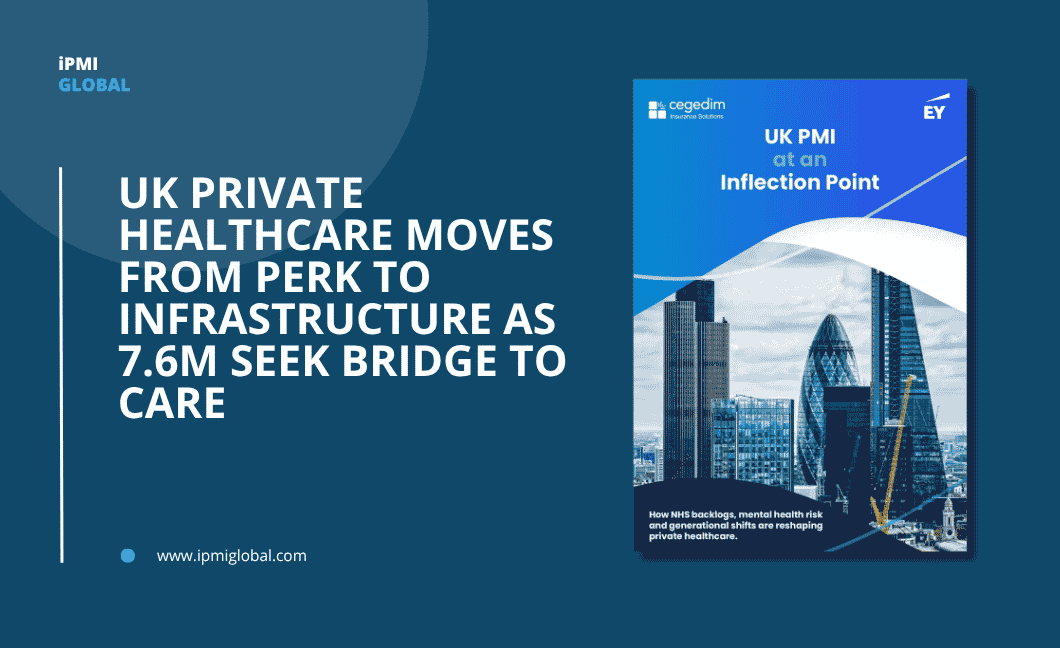
Cegedim Insurance Solutions and EY have issued a joint report sounding a stark warning to the UK health insurance sector: Private Medical Insurance (PMI) has reached a definitive "inflection point." No longer a discretionary executive perk, PMI has matured into a foundational component of UK workforce infrastructure. Driven by a profound erosion of confidence in public healthcare provision, 7.6 million people—representing 14% of the UK adult population—now hold private cover. This shift signals a permanent structural realignment where private access is viewed as an essential bridge to care rather than a premium alternative.
RELATED READING: BMI Launches Digital Transformation Across Latin America with Cegedim’s Actisure Platform
The report identifies that current market growth is decoupled from traditional economic cycles, fuelled instead by a systemic "loss of confidence" in public systems. For insurers and employers, the "utility" of healthcare has superseded the "prestige" of private treatment. As public backlogs become a predictable feature of the landscape, PMI has transitioned into a pragmatic operational tool designed to restore predictability to workforce management and economic productivity.
James Stokoe, Chief Executive Officer, Cegedim Insurance Solutions told iPMI Global, “PMI in the UK is no longer simply an executive benefit viewed as a luxury by employees and employers, it has become an essential part of the UK's healthcare ecosystem. With 7.6 million people now covered, the market is responding to a structural change in demand as individuals seek faster, more reliable access to treatment and employers want a healthy productive workforce.”
The Five Forces Reshaping the PMI Landscape
The expansion of the market represents a fundamental step-change in healthcare behaviour. To maintain relevance, industry stakeholders must navigate five convergent forces that have transformed the "So What?" for insurance value propositions:
|
Force |
Strategic Impact ("The So What?") |
|
NHS Pressure |
Predictability has replaced premium comfort. With private admissions up 20% compared to the 2021-2023 recovery period, users view PMI as a pragmatic bridge to care in an era where public delays are now a predictable outcome. |
|
Mental Health |
This has evolved from a wellbeing challenge into a critical productivity risk. Employers now treat mental health access as a foundational requirement to mitigate the pervasive costs of presenteeism and long-term sickness. |
|
Gen Z Expectations |
For the emerging workforce, digital-first engagement and values-aligned service are the non-negotiable baseline. They have zero tolerance for the "analog" friction inherent in legacy insurance models. |
|
Generational Shifts |
The aging workforce faces a "healthcare cliff-edge." Insurers risk significant churn and "affordability shocks" if they fail to bridge the gap between corporate schemes and individual markets. |
|
Technology & Data |
In a high-volume environment, operational capability is no longer a back-office function—it is a core competitive differentiator. |
The Evolution of Employer Priorities: From Prestige to Utility
The legacy of COVID-19 has permanently dismantled the traditional hierarchy of health benefits. Employers have moved away from the "hospitality" aspects of private care, such as consultant choice and room comfort, in favour of outcome-oriented service delivery. This represents a strategic shift toward utility: the speed and reliability of returning an employee to health is now the primary metric of value.
Addressing the Generational Chasm: Gen Z and the Retirement "Cliff-Edge"
Insurers are currently caught between the on-demand digital requirements of Gen Z and the looming "affordability shock" facing retiring members.
Gen Z: The Present Reality
This demographic is reshaping the market through three core pillars:
- Digital-First Baseline: Mobile-first, self-service journeys are the minimum standard.
- Mental Health Proactivity: A higher propensity to seek early support, judging providers on "speed to first contact."
- Sustainability & Values: 75% of Gen Z’s purchasing decisions are influenced by a brand’s commitment to sustainability—a factor that now directly impacts insurer and employer selection.
The Retirement Challenge
Simultaneously, the industry faces a strategic "retention risk" as the workforce ages. Historically, the transition from corporate to individual cover has been fraught with "affordability shocks" and increased sensitivity to premium pricing. Insurers can no longer afford to treat these as separate markets. Failure to provide "flexible continuity models" and seamless transition journeys creates a healthcare cliff-edge that threatens the long-term stability of the individual payer market.
Technological Modernisation: Moving Beyond "Kicking the Can"
For years, the health-tech landscape has been characterized by legacy systems and fragmented global models. This reliance on aging technology has effectively "kicked the can down the road," hindering innovation. While the regulator’s caution regarding the ethics of AI in "life-changing scenarios" has historically caused hesitation, the maturation of technology has made modernisation an urgent necessity.
Key Finding: Insurers are projected to achieve 20%+ average cost savings from AI-related productivity enhancements over the next two years.
The report identifies "agentic AI" as the primary vehicle for this transformation. By moving from manual operating models to autonomous systems that facilitate diagnosis and claims fulfilment, insurers can finally achieve the scale required to meet rising volumes. In this new landscape, agentic AI is not just an efficiency play; it is a core competitive differentiator for players looking to survive the transition to high-volume, high-expectation care.
Conclusion: A Market Driven by Necessity
iPMI Global CEO Christopher Knight concludes, “The UK PMI market has transitioned from a luxury sector to a vital utility. Growth is no longer a byproduct of economic prosperity but a direct result of structural healthcare pressures. For insurers, brokers, and HR leaders, the risk of inaction is extreme. In a market where operational friction now defines brand perception more than clinical outcomes, underperformance is more visible—and less forgivable—than ever before.”
Download a complete copy of the report here: https://www.cegedim-insurance.com/Pages/documents.aspx
About Cegedim Insurance Solutions
Cegedim Insurance Solutions is a leading provider of innovative technology and services for the healthcare insurance industry. We deliver high-performance platforms that enable insurers to modernise operations, optimize data accuracy, and redefine the customer experience through radical digitisation.
About EY
EY is a global leader in assurance, tax, transaction, and advisory services. Its healthcare and insurance practices provide the strategic foresight and transformation expertise necessary for organisations to navigate regulatory shifts, demographic transitions, and the integration of agentic AI.