
The Maritime Insurance Shock of the Juffair Strike: Market Implications and Operational Realities
- Written by: iPMI Global
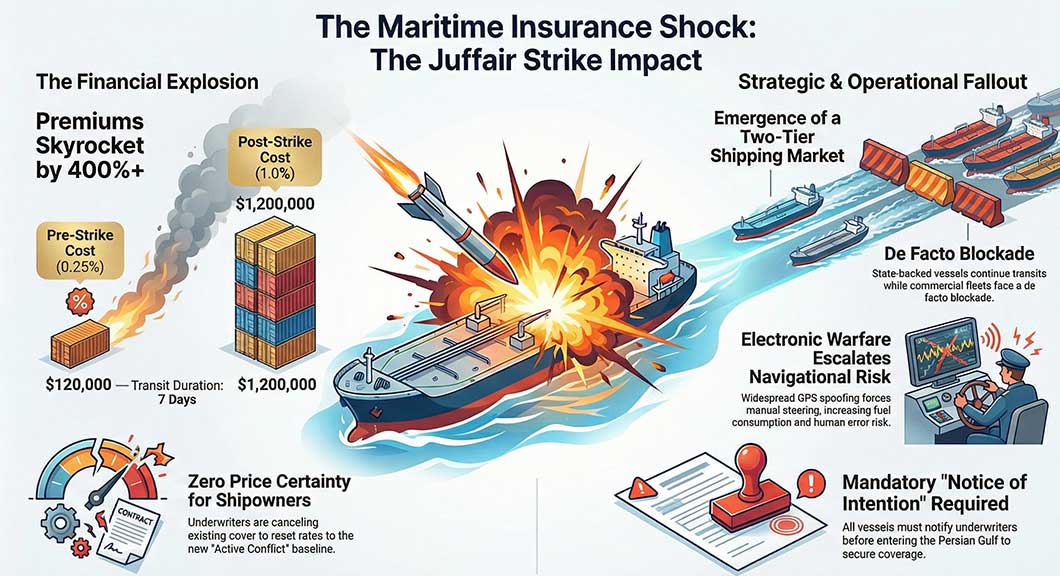
In this iPMI Global Maritime Intelligence Article we outline the massive financial crisis in the maritime industry following a military strike on the U.S. 5th Fleet in Bahrain. In response to heightened conflict, insurance underwriters are dramatically increasing premiums, with costs for transiting the Strait of Hormuz surging to nearly ten times their previous rates. This volatility has forced insurers to cancel existing coverage agreements to reset prices, while simultaneously demanding mandatory notifications from any vessel entering the Persian Gulf.
Beyond simple price hikes, electronic warfare and GPS interference are further complicating navigation, leading to additional risk surcharges. These developments threaten to create a two-tier shipping market, where only state-backed vessels can afford to operate. Ultimately, the high cost of protection may act as a functional blockade for commercial ships, as insurance expenses begin to outweigh the value of the cargo itself.
Maritime Insurance Premiums Iran War
The missile strike on the U.S. 5th Fleet in Bahrain and subsequent interceptions over the UAE on February 28, 2026, have triggered a "vertical spike" in maritime insurance costs. The market has shifted from assessing "risk" to pricing in the "certainty" of active conflict. Key takeaways include:
- Premium Surge: Additional War Risk Premiums (AWRP) for the Strait of Hormuz have escalated from a pre-strike range of 0.1%–0.25% to as high as 1.0% for a single seven-day transit.
- Price Volatility: Shipowners no longer have price certainty, as underwriters invoke "Held Covered" provisions at market rates at the time of entry and issue 7-day cancellation notices to reset baselines.
- Operational Interference: IRGC electronic warfare, specifically GPS spoofing and jamming, is increasing "Human Error" risk premiums and fuel consumption.
- Market Bifurcation: A "Two-Tier" shipping market is emerging, where state-backed vessels (e.g., from China) continue operations while Western commercial fleets face de facto blockades due to prohibitive insurance costs.
1. Vertical Spike in Premium Rates
The market advisory indicates an unprecedented move in the Lloyd’s market following the Juffair strike. The financial burden of entry into the Persian Gulf has transitioned from a manageable operational cost to a significant capital expenditure.
Comparative Rate Analysis
|
Metric |
Pre-Strike Levels |
Post-Strike Levels |
|
AWRP Rate |
0.1% – 0.25% |
0.7% – 1.0% |
|
Transit Duration |
Standard |
Single 7-day transit |
|
Cost for VLCC ($120M) |
$120,000 – $300,000 |
Up to $1,200,000 |
This immediate $1.2 million insurance cost for a single Very Large Crude Carrier (VLCC) transit represents a critical threat to the commercial margins of cargo transport.
2. Operational Risks: Electronic Warfare and GPS Spoofing
Beyond direct kinetic threats, the insurance market is pricing in the risks associated with electronic warfare (EW) activity attributed to the IRGC.
- GPS Spoofing & Jamming: Significant interference has been reported within a 100km radius of the Strait of Hormuz.
- Impact on Navigation: These disruptions have forced vessels to abandon autopilot systems.
- Compounding Costs: The shift to manual navigation has two primary financial consequences:
- Increased Fuel Consumption: Non-optimized manual routing increases fuel burn.
- Human Error Premiums: Underwriters are applying surcharges due to the heightened risk of accidents resulting from manual navigation in contested waters.
3. Regulatory and Policy Shifts
The Joint War Committee (JWC) is responding to the strike with emergency measures that strip shipowners of financial predictability.
- JWC "Listed Area" Updates: An emergency update to the JWLA-032 listed areas is expected, redefining the geography of high-risk zones.
- Notice of Intention: All vessels are now under a mandatory requirement to notify underwriters before entering the Persian Gulf.
Loss of Price Certainty
- Held Covered (HC) Provisions: While policies generally remain in effect, they are being invoked at "Market Rates at Time of Entry."
- Cancellation Notices: Underwriters are utilizing 7-day Notice of Cancellation clauses on existing war risk cover to forcefully reset rates to the new "Active Conflict" baseline.
4. Impact on Cargo and P&I Clubs
The instability extends beyond hull insurance into cargo and liability coverage, affecting regional trade hubs like Bahrain, Kuwait, and Qatar.
Cargo Insurance (WSRCC): Rates for "War, Strikes, Riots and Civil Commotion" are no longer available for long-term locks. All quotes are currently being issued on a "per-voyage" basis only.
P&I (Protection & Indemnity) Scarcity
The International Group of P&I Clubs is on high alert for massive pollution claims should a tanker be struck.
Reinsurance Withdrawal: Reinsurers are pulling back capacity as they assess the scale of U.S.-Israeli operations, making Excess War Risk P&I cover increasingly scarce.
5. Strategic Conclusion: The Two-Tier Shipping Market
The current "War Exclusion" has shifted from a theoretical policy clause to an operational reality. The document concludes that the maritime sector is splitting into two distinct categories:
State-Backed Vessels: Ships from nations capable of providing sovereign guarantees (specifically citing China) are expected to continue transiting the region, bypassed by the commercial insurance crisis.
The Commercial Fleet: Western-insured vessels are facing "de facto" blockades. In many instances, the surge in insurance premiums now exceeds the total commercial margin of the cargo, making transit economically non-viable.