
The End of the Low-Risk Era: Re-Engineering iPMI and Duty of Care for a Middle East at War
- Written by: iPMI Global
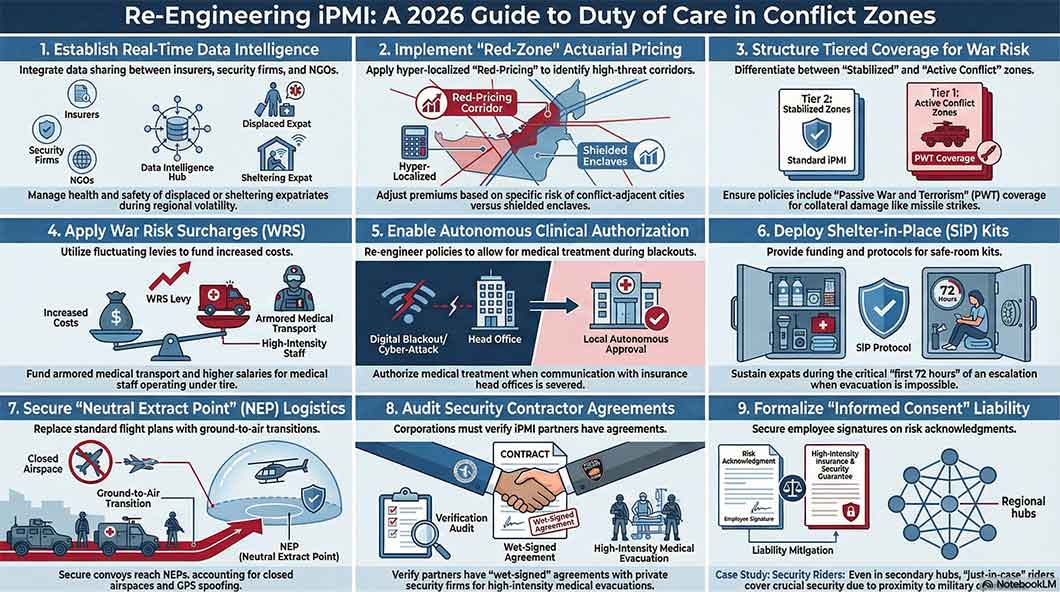
In this iPMI Global article we outline a dramatic transformation in the international medical insurance industry as it adapts to heightened geopolitical instability in the Middle East. By 2026, providers have shifted from passive coverage to dynamic intervention, incorporating autonomous clinical authorizations and localized "Red-Pricing" models to manage war-related risks. Duty of Care obligations for corporations have expanded significantly, now requiring comprehensive safety nets that include psychological trauma support, secure evacuations, and "shelter-in-place" protocols.
To maintain financial stability, insurers have introduced War Risk Surcharges and specific riders for even traditionally safe hubs like the UAE. Ultimately, the industry is transitioning from a simple financial service into a life-safety partnership that prioritizes real-time threat intelligence and physical security. This evolution reflects a new reality where informed consent and high-intensity logistical support are essential for protecting expatriates in active conflict zones.
1. Middle East Emergency International Private Medical Insurance Round Table 2026
In early 2026, industry leaders will convene for an emergency round table to address the unprecedented volatility across the Levant and Gulf regions. The consensus is clear: the traditional "safe haven" status of several key expat hubs is being stress-tested. The round table will highlight the critical need for real-time data sharing between insurers, security firms, and NGOs to manage the health and safety of thousands of displaced or sheltering expatriates.
2. Re-engineering iPMI for War Zones
Standard iPMI products were never designed to withstand the systemic shocks of a regional conflict. Re-engineering these policies in 2026 involves moving away from "passive coverage" to "dynamic intervention." This includes the integration of autonomous clinical authorization—allowing for medical treatment even when digital blackouts or cyber-attacks sever communication with head offices.
3. Duty of Care in Middle East Conflict
"Duty of Care" has evolved from a corporate buzzword into a legal and moral imperative. In the context of the current Middle East conflict, this mandate extends beyond providing a health card; it requires a proactive 360-degree safety net. Organizations are now expected to provide psychological support for trauma, real-time threat intelligence, and guaranteed access to stabilized medical facilities amidst regional instability.
4. Expatriate Healthcare Insurance for High-Risk Zones 2026
Insuring expatriates in 2026 requires a tiered approach to risk. New policy structures differentiate between "Stabilized Zones" and "Active Conflict Zones." High-risk insurance now frequently includes specific provisions for "Passive War and Terrorism" (PWT) coverage, ensuring that an individual injured by collateral damage—such as a missile strike in a residential area—remains fully covered.
5. Red-Pricing the "Red Zone" Middle East
The "Red-Pricing" model has emerged as the new actuarial standard. By identifying specific high-threat corridors, insurers are applying hyper-localized pricing. This means a policy for an expat in a conflict-adjacent city will carry a vastly different risk premium than one in a shielded enclave, reflecting the localized reality of the "Red Zone" map.
6. War Risk Surcharges for iPMI 2026
To maintain the solvency of the iPMI pool, 2026 has seen the widespread implementation of War Risk Surcharges. These are transparent, fluctuating levies applied to premiums based on the intensity of local military operations. These surcharges fund the increased cost of medical logistics, such as armoured transport for patients and the higher salaries required for medical staff willing to operate in "Active Risk" zones.
7. Corporate Duty of Care Middle East 2026
For corporations, the 2026 landscape demands a "boots-on-the-ground" approach to Duty of Care. Firms are now auditing their iPMI partners not just on price, but on their ability to perform under fire. This includes verifying that insurers have "wet-signed" agreements with private security contractors for secure medical evacuations.
8. Expat Evacuation Protocols from War Zones
Evacuation is no longer a simple flight out. 2026 protocols now account for closed airspaces and GPS spoofing. Modern evacuation plans prioritize ground-to-air transitions, utilizing secure convoys to reach "Neutral Extract Points" (NEPs). Insurance providers are increasingly embedding these complex logistical costs directly into the core iPMI premium.
9. Security Evacuation Insurance Riders: UAE and Qatar
Historically considered "low risk," the UAE and Qatar have seen a surge in demand for security evacuation riders. While these hubs remain secondary to the direct conflict, the proximity to military operations has prompted a "just-in-case" mindset. These riders cover the costs of political evacuation, temporary relocation allowances, and specialized security details.
10. Liability for Employees in "Active Risk" Zones
The legal burden on employers has reached a tipping point. Failure to provide adequate coverage or accurate risk briefings in "Active Risk" zones can lead to massive liability claims. In 2026, "Informed Consent" forms are becoming standard—where employees acknowledge the risks, but employers simultaneously guarantee a specified level of high-intensity iPMI and security support.
11. Safe-Room and Shelter-in-Place Protocols for Expats
As modern warfare reaches urban centres, iPMI providers are now offering advice—and in some cases, funding—for safe-room and shelter-in-place (SiP) kits. These protocols are designed to keep expats safe during the critical "first 72 hours" of an escalation when evacuation may be physically impossible. This represents a radical shift from "medical insurer" to "life-safety partner."
Conclusion
The transition from a "tax-free paradise" to a "high-stakes premium hub" represents the most significant evolution in the history of the Middle Eastern expat market. As the boundary between civilian life and military operations blurs, the role of iPMI must shift from a background utility to a frontline defense.
In conclusion iPMI Global CEO Christopher Knight said, "In 2026, the 'Dubai Dream' and the wider Middle East opportunity have not vanished, but they have been recalibrated. We have transitioned from an era of passive coverage to one of active resilience. For the modern expatriate and the global corporation, the ultimate currency is no longer just a tax-free salary—it is the certainty of a secured exit and the guarantee of care when the horizon turns red."
