
Hundreds of Thousands of Travellers Stranded or Diverted Amid Air Space Closures in Middle East
- Written by: iPMI Global
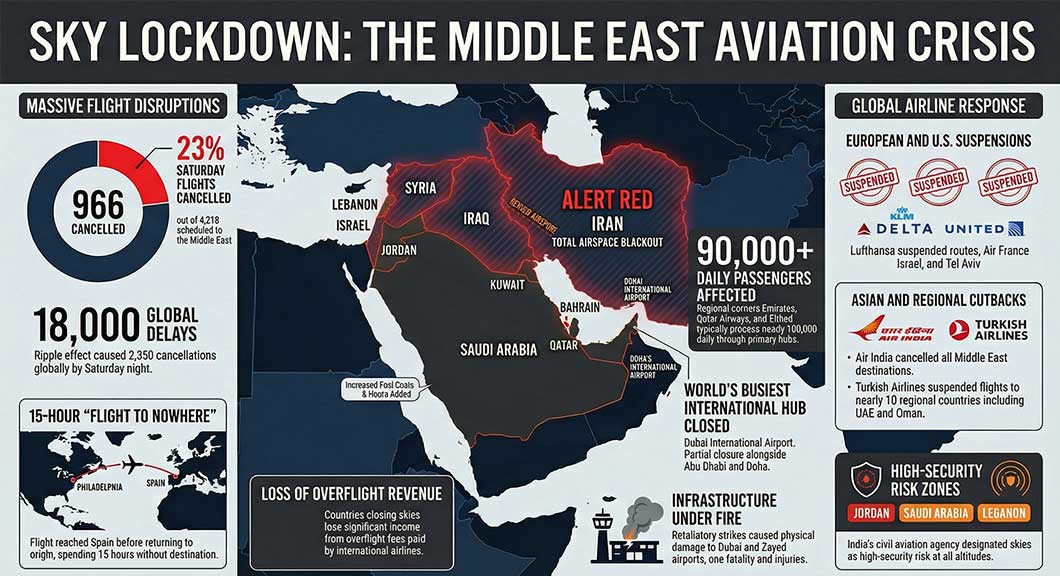
Recent military tensions involving Israel and the United States against Iran have caused unprecedented flight disruptions throughout the Middle East. Numerous nations moved to close their airspace, leading to the cancellation of thousands of flights and the grounding of hundreds of thousands of travelers. Major global transit hubs in the United Arab Emirates and Qatar were forced to halt operations, while international carriers implemented lengthy rerouting strategies to bypass high-risk zones.
This logistical crisis has resulted in reported injuries at regional airports and significant financial strain on the aviation industry due to increased fuel costs and lost fees. Analysts suggest that while some corridors may reopen as the military situation stabilizes, passengers should anticipate prolonged delays and potential fare increases.
Strategic Travel Advisory: Middle Eastern Airspace Crisis and Global Aviation Impact
1. The Regional Aviation Shutdown
The Middle East serves as the primary global transit artery, acting as the indispensable geographical bridge connecting Europe, Africa, and the West to Asia and Australia. The recent escalation in conflict—specifically the American and Israeli attacks on Iran—has effectively severed these key East-West travel corridors. This disruption is particularly acute for the "Kangaroo Route" and other long-haul paths that rely on the region's stability. By forcing the immediate closure of vast swathes of regional airspace, the conflict has paralyzed international transit and left hundreds of thousands of travellers stranded.
The regional shutdown is characterized by a mix of total and strategic closures:
- Total Airspace Closures: Israel, Qatar, Syria, Iran, Iraq, Kuwait, and Bahrain.
- Temporary and Partial Closures: The United Arab Emirates (UAE).
This collective suspension of civilian aviation has triggered a systemic paralysis of the world’s most critical international hubs, moving beyond mere delays into a state of total operational stasis.
2. Impact Assessment: Global Transit Hubs and Infrastructure Damage
The global aviation network relies heavily on the "Big Three" hubs—Dubai International (DXB), Zayed International (Abu Dhabi), and Doha (Hamad International). When these operational anchors are compromised, the ripple effects degrade the entire global flight schedule. Dubai International, the world’s busiest hub for international travel, is the epicentre of this instability.
The scale of the disruption is unprecedented, as evidenced by data from Cirium and FlightRadar24:
|
Metric |
Impact Data |
|
Daily Passenger Volume |
90,000+ (Emirates, Qatar Airways, and Etihad combined) |
|
Saturday Cancellations |
966 flights (22.9% of all regional scheduled landings) |
|
Total Global Delays |
18,000+ flights |
|
Total Global Cancellations |
2,350+ flights |
Physical infrastructure damage has significantly escalated the risk profile for personnel and passengers. Reports indicate that Dubai International Airport and the Burj Al Arab hotel sustained damage, resulting in four injuries. Furthermore, Abu Dhabi’s Zayed International Airport was the site of a high-impact incident. Although a post on X reporting one fatality and seven injuries was later deleted by Abu Dhabi Airports, the report underscores the extreme physical hazards currently present.
This direct threat to ground infrastructure and civilian safety has necessitated immediate and drastic service suspensions from international carriers.
3. Carrier-Specific Responses and Service Suspensions
For corporate risk managers and expatriates, airline-specific status is the primary variable in contingency planning. Carriers have moved aggressively to mitigate exposure to kinetic activity.
Regional Giants
Emirates, Qatar Airways, and Etihad: Combined cancellations exceed 1,000 flights as their primary hubs were shuttered.
Turkish Airlines: Suspended until Monday: Lebanon, Syria, Iraq, Iran, and Jordan.
Indefinite Suspension: Qatar, Kuwait, Bahrain, the UAE, and Oman.
International and Western Carriers
Delta and United: Service to Tel Aviv suspended through the weekend.
British Airways: Tel Aviv and Bahrain suspended until next week; Amman services cancelled.
Lufthansa, Air France, Transavia, and Pegasus: Total suspension of Lebanon operations.
KLM: Ongoing suspension of all Tel Aviv flights.
American Airlines: Suspended the Philadelphia–Doha route.
High-Security Designations
The Indian civil aviation agency has officially designated the skies over Jordan, Saudi Arabia, and Lebanon as high-security risk zones at all altitudes. Consequently, Air India has ceased all operations to Middle Eastern destinations.
The "Reroute vs. Suspend" Strategy
Airlines are bifurcated between total suspension and costly rerouting. Virgin Atlantic is avoiding Iraqi and Iranian airspace, implementing strict fuel-loading protocols to allow for short-notice diversions on routes to India, the Maldives, and Riyadh. These tactical shifts result in significantly longer flight durations and increased operational complexity.
This operational retreat leads directly to severe logistical bottlenecks and mounting financial consequences for the global economy.
4. The "So What?" Layer: Logistical Realities and Economic Consequences
From a risk management perspective, the transition from a "standard delay" to a regional crisis introduces secondary effects that will impact global supply chains and travel budgets. As flights are forced to reroute south over Saudi Arabia, several critical economic factors emerge:
Operational Cost Surges: Increased flight durations lead to massive fuel consumption. These costs will inevitably be passed to consumers through ticket price hikes if the conflict lingers.
Air Traffic Pressure: The influx of diverted traffic is straining Saudi Arabian air traffic controllers, who may be forced to slow traffic to maintain safety margins.
Revenue Depletion: Nations maintaining closures, such as Iran and Iraq, face a total loss of overflight fees, impacting their civil aviation budgets.
The "human cost" is characterized by total information vacuum and logistical failure. One Philadelphia-based flight spent 15 hours in the air, reaching Spain before turning back to its origin. On the ground, the experience of travellers like Jonathan Escott—whose Emirates flight from Newcastle was cancelled—highlights the chaos. Escott noted that even major carriers like Emirates "don’t have a clue" regarding the timeline for resumption. This lack of actionable data is a primary risk for stranded personnel.
5. Strategic Outlook and Risk Mitigation Recommendations
The security environment remains highly volatile, requiring a forward-looking approach to travel security. A critical historical benchmark is the June 2025 conflict, which lasted 12 days; this suggests that recovery from the current disruption will not be instantaneous even after a ceasefire.
Aviation experts Henry Harteveldt and Mike McCormick identify the next 24 to 36 hours as a critical window. During this time, military flight paths will be better defined, potentially allowing for the "partial" reopening of specific corridors.
Actionable Risk Mitigation:
Monitor the 24–36 Hour Window: Watch for specific corridor reopenings as Iranian missile capabilities and military flight paths are clarified by regional authorities.
Verify Status Prior to Departure: Do not rely on airport displays; verify status via airline apps and digital channels, as the information gap remains significant.
Utilize Financial Protections: Leverage rebooking waivers and fare-difference protections currently offered by major carriers to secure alternative routing.
Contingency Fuelling and Planning: For organizations operating private or chartered aviation, ensure strict adherence to fuel-loading protocols similar to Virgin Atlantic’s "reroute-ready" posture.
The current crisis demands extreme vigilance and flexibility; until kinetic activity subsides and airspace is fully cleared, the Middle East will remain a zone of prohibitive operational risk.