
iPMI Global Speaks with Founders Helle Kirkegaard and Ida Berg Schaldemose, One Health Insurance
- Written by: iPMI Global
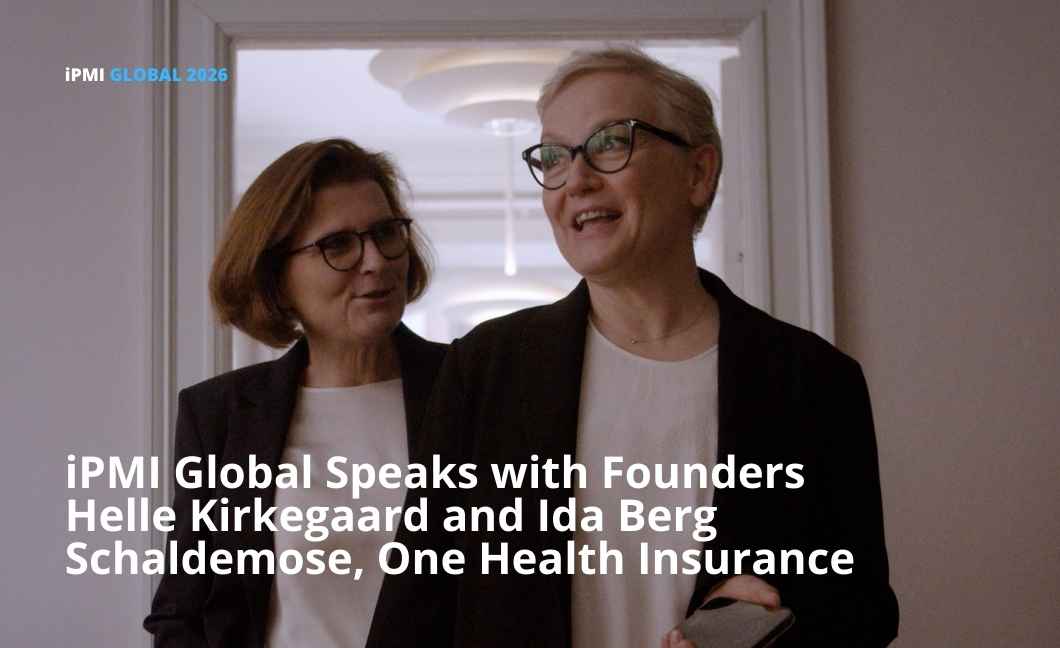
In this interview series, iPMI Global explores the shifting landscape of international healthcare with the industry’s most influential leaders. Today, we are joined by Ida Berg Schaldemose and Helle Kirkegaard, co-founders and co-CEOs of One Health Insurance, a boutique provider that has carved out a distinct niche by prioritizing a high-touch, "human-first" approach in an increasingly automated global market.
Under their leadership, One Health Insurance continues the 50-year legacy of the globally recognised International Health Insurance (IHI) in Copenhagen. The insurance coverage and service model are specially designed for the client who expects excellence.
With over two decades of experience in the international insurance space, the team at One Health Insurance brings a unique perspective on the growing demand for tailored solutions and personal and individual concierge style service.
In this discussion, we dive into the challenges of scaling a boutique brand, the importance of maintaining a human touch in the age of AI, and how their team navigates the complex, "multi-local" lifestyles of today’s global elite.
You have a deep background in the international insurance space. What was the specific "gap" or "problem" in the market that inspired the leadership direction you’ve taken at One Health Insurace?
When the IHI Copenhagen office was closed after 48 years of being established and 17 years after being acquired, we received a lot of feedback from clients and brokers who told us that they missed the high quality, personalised service.
Many experts in the industry confirmed our perception that no one took the space left by IHI. Most big insurers have to run a high-volume approach. While many new Master General Agents have come into the IPMI market, none had a focus of the individual customers demanding personalised, white glove service.
Our clients are telling us that they have had previous experience with their health insurances where they felt they were just a number, found it difficult to get through to an employee who were able to make decisions and had to spend much time with even simple claims and so on.
They are looking for a solution that mirror what they receive from their advisors, providers and brands.
Speaking the language of the clients and brokers is also a feature that we prioritise to offer. Most feel more comfortable speaking their own language when having a medical condition.
Many brokers feel like "just another number" to the major global insurers. How does One Health empower specialist brokers to offer something unique to their clients that isn't just about price?
The specialised brokers we work with have the same experience as our clients when working with the bigger insurers and MGAs and are also looking for a partner that can provide an individualised and personal service.
We want to help the brokers as much as we can so that they can deliver excellence to their clients.
We work with brokers we have known for more than 20 years. New, specialised brokers have also joined, as they have been attracted to our proposition.
We are built on a 50-year legacy of excellence and choose our partners carefully and with the understanding that our values need to match.
You refer to One Health as a "boutique" provider. In practical terms, how does this change the day-to-day experience for a member? For instance, do they have a dedicated "Health Concierge" they can call by name?
Yes, each client has a dedicated client manager who looks after the client and his/her family. Like they have with their wealth managers, bankers and Family Office.
The client manager is familiar with the medical history of the client and family members and understands how best to assist in any medical situation that might arise.
Clients tell us that they truly appreciate that they can call and speak to one who knows them and not having to tell their story and case multiple times. Most people avoid call centers for this reason.
Brokers tell us that the trust and relationship we have been building through many years make it easy for them to manage their clients as they know that we are here to support them delivering the best for the clients.
We all actually really enjoy interacting with clients and brokers. Supporting clients and brokers is what drives us. And it energizes us to meet new clients and brokers.
While iPMI is often about relocation, your HNW (High Net Worth) clients often live "multi-local" lives with homes in three different countries. How do you structure a policy that doesn't just "cover travel" but feels like a local, primary plan in every territory they inhabit?
Our propositions are designed to work for clients in their home country/countries as well as when travelling. We do not distinguish.
Our fundamental design principle behind our insurance cover and our service, is for our clients to live the life they envision.
Our solutions have worked for these clients for many years and are flexible to work in multiple countries. The brokers we work with understand how best to structure the offering to each client based on the client’s needs and demands. And if these change, we offer flexible ways to design a solution that fits the new situation. We understand that these clients need flexibility from us to adapt details on their cover during the client’s life.
OHI targets clients that are looking for a lifetime cover and hence our propositions can adapt during the lifetime of the client.
In the insurance world, the "moment of truth" is the claim. Can you walk us through a recent "complex claim" where the One Health team went above and beyond the standard policy wording to help a member?
Case 1) We had a client with four different diagnoses. What was important in this case was to organise which diagnosis to focus on first and find a provider to identify treatment for this diagnosis, before moving to the other diagnoses. We assisted the client in a plan of approach, and the treating doctors took the lead on the treatment plan.
Case 2) Another complex situation was a situation of rare disease. We made sure that the client received second and a third medical opinion to understand if options were available in other countries than the client’s home country.
Case 3) We had a client with a need for a future kidney transplant, where we coordinated a review of the options within a specific region and listed recognised providers that the client could consult in terms of how to manage the situation, prepare for a transplant and understand life after a transplant.
Case 4) We have had clients with cancer. And in these cases, our role is to make sure the clients find a provider they trust, and that we know can treat the specific type of cancer. Funding is basics. The key value we offer is supporting the client and family members before, during and after especially where they can receive support.
Case 5) A simple thing we can do is for instance to pay for an extra night if the client needs this before the operation to secure that the client is mentally and physically prepared for the operation. We believe this flexibility increases the client’s outcome of the operation.
Case 6) Sometimes it is about speed more than complexity. Finding a provider and getting access to a qualified provider immediately, perhaps not because the condition is complex or serious but because time is of essence to this client. Understanding that urgency for the client is not necessarily similar to medical urgency. Understanding this, is part of our DNA.
For a boutique firm, maintaining a global provider network is a massive undertaking. How do you ensure your members get that "seamless direct billing" experience even in remote or ultra-exclusive medical facilities?
We work with multiple partners to ensure that if our clients prefer us to pay direct, we can accommodate this. What is key, is to offer the clients the options to pay themselves or ask us to pay direct. We have both options.
The clients often decide which provider they prefer and often pay themselves and when they ask us for reimbursement. And our ambition is to process the reimbursement within 48 hours. To be able to do this, we have organised a bank that can provide this service.
Denmark is consistently ranked as one of the world’s happiest and healthiest nations. Are there specific "Danish values" or healthcare philosophies that you’ve exported into the way One Health operates internationally?
Happiness comes from high levels of trust in people and institutions, a strong social safety net, and excellent work-life balance. This we know that the clients and brokers appreciate in our interactions.
Being Danish and being a business based in Denmark comes with some innate benefits. High education, international mindset, high social trust, low power distance, world’s least corrupt country and high CSR standards, are among the benefits.
For us this means that we have access to highly skilled and qualified staff. We can delegate responsibility to client managers to secure that the clients receive qualified and immediate response.
One Health Insurance emphasizes a very personal, "concierge" style of service. In an industry dominated by massive global players and automated systems, how do you maintain that intimate "Danish-speaking team" feel while operating on a global scale?
By employing people based on their values, service mindset, language capabilities and cultural understanding.
From our time in IHI, we saw that the DNA of IHI, was kept intact despite growing from 5 to 700 employees and even in the IHI offices in other countries. Secured through a specific recruitment model and management model.
Service management is about how many clients you retain and not by how many calls or mails you can answer in a minute. Quality is key rather than having an industrial paradigm about quantity.
Your website mentions that you put "peace of mind and fast access to treatment" above standard insurance metrics. How does One Health define "success" differently than a traditional volume-based insurer?
Success is defined by each client. It can be about speed, quality or any other metric or multiple metrics. And it might change depending on the situation. Each client defines what is important for them. In our welcome call with the client, we ask for what the clients define as success. This is the basis for future interactions, and we adapt if clients redefine the success metrics.
If the client has a broker, we also make sure to be in close contact with the broker.
We note how the client prefers to be contacted, which channels they prefer to communicate through and how they want us to interact with their broker or their PA or both and we adapt.
In traditional companies’ success is often defined by inside out metrics and same independent of clients. Big companies might have to have “one size fits all” because of size.
The ratio of clients per employee is lower with us than a traditional company. This ensures that cases and enquiries receive more attention and we can respond faster. This is what the clients pay for because they appreciate being serviced individually and in a personal manner.
One Health has a strong value proposition for Family Offices and HNWIs. What are the unique challenges of serving this specific demographic compared to a standard corporate group?
Family Office clients are about receiving high quality. And being able to adapt to each client’s needs and demands.
Our team members have been working with this clientele for more than 20 years and are professional and discrete by nature. The Client Manager will serve as one point of contact to a vast network of experts in order to respect the fact that time is precious for this clientele.
What we focus on is being able to adapt our approach and way of servicing. They are very different in what they ask for, and we offer a model that is flexible.

