
2026 Strategic Regional Security Assessment for Expatriates, HR Managers and Travellers: Middle East Combat Environment
- Written by: iPMI Global
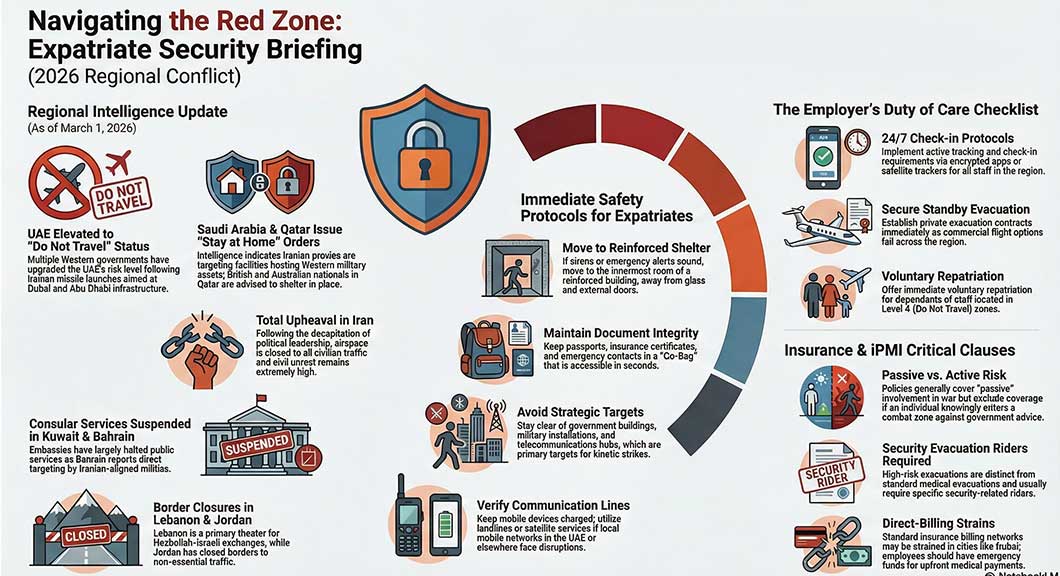
In this iPMI Global risk advisory, we outline the severe regional conflict in the Middle East following significant military strikes against Iran and the subsequent death of its leader. Because traditional expatriate hubs like the UAE and Qatar are now facing direct threats and travel bans, international organizations must shift from standard operations to active crisis management.
This risk advisory emphasizes that employers have a legal and ethical duty of care to implement check-in protocols and secure private evacuation services for their staff. Travellers are advised to shelter in place and avoid strategic targets, while maintaining a state of constant readiness for emergency departures.
Finally, we highlight the complexities of international health insurance, noting that standard policies may require specific riders to cover security evacuations in active war zones.
1. Executive Overview of the Post-February 28 Geopolitical Landscape
The regional security architecture of the Middle East underwent a fundamental and irreversible shift following the kinetic operations of February 28, 2026. The decapitation of the Iranian political leadership, including the death of Supreme Leader Ali Khamenei, has catalysed a transition from "heightened awareness" to a "full-scale regional war" footing. For all organizational stakeholders, this environment demands an immediate pivot to active crisis management. The primary risk is no longer state-on-state conventional warfare alone, but the volatility inherent in a vacuum of power; the breakdown of centralized command and control within Iranian structures has left proxy units decentralized and highly unpredictable.
- Current Status: Active Combat Environment / Full-Scale Regional War
- Primary Drivers: Death of Iranian Supreme Leader; collapse of IRGC centralized command; ongoing retaliatory strikes; closure of strategic civilian airspace.
- Intelligence Insight: The "Red Zone" designation is driven by the high probability of "rogue" proxy actions. Without a central authority in Tehran to restrain them, regional militias are likely to engage in asymmetrical targeting of Western assets with zero lead time.
- Operational Directive: Immediate cessation of non-essential movement and activation of extraction contingencies.
This assessment provides the necessary intelligence to bridge the gap between broad geopolitical shifts and the specific survival protocols required for personnel in regional hubs.
2. Ground Reality Analysis: Regional Hub Safety & Operational Status
The strategic viability of an organization’s regional footprint is now dictated by the stability of traditionally "safe" hubs. The UAE, Saudi Arabia, and Qatar have transitioned from business gateways to high-friction combat zones, necessitating a total re-evaluation of personnel presence.
Regional Hub Security Matrix
|
Location |
Current Safety Status (Western Govs) |
Intelligence-Based Ground Reality |
Movement Directives |
|
United Arab Emirates |
Do Not Travel |
Historic anomaly; missile "interception booms" and debris; severe infrastructure disruption. |
Restricted: Emergency mobile alerts must be followed as law. |
|
Saudi Arabia |
High Risk / Warning |
Proxies targeting facilities hosting Western military/strategic assets. |
Mandatory: Strict "Stay at Home" order for all foreign nationals. |
|
Qatar |
High Risk / Warning |
High risk of projectile impact; targeting of Western-affiliated sites. |
Shelter in Place: Directive specifically for British and Australian nationals. |
|
Iran |
Do Not Travel |
Total upheaval; civil unrest; closed airspace; leadership vacuum. |
Emergency Exit: Immediate contact with embassy hotlines required. |
Operational Impact on Infrastructure
In the United Arab Emirates, the current "Do Not Travel" status represents a historic realignment of regional risk. While missile defence remains effective, the debris from interceptions and the associated "interception booms" have rendered civilian life untenable. Crucially, the temporary closures of Dubai and Abu Dhabi airports have resulted in the severing of primary business continuity routes, effectively trapping assets and personnel within the theatre.
In Saudi Arabia and Qatar, the "Stay at Home" and "Shelter in Place" orders are not mere suggestions; they are reactions to credible intelligence regarding proxy targeting of installations hosting Western military assets. Proximity to these installations is now the single greatest risk factor for expatriate personnel.
Status of Peripheral Hubs and the Levant
Kuwait & Bahrain: Public consular services are suspended. Bahrain is on high alert following direct targeting by Iranian-aligned militias.
Lebanon: Most of the country is a "High-Risk Zone" due to intensive Hezbollah-Israeli kinetic exchanges.
Jordan: Amman has suspended diplomatic operations, and borders are closed to non-essential traffic.
These ground realities demand that leadership move beyond corporate policy and enforce combat-environment survival protocols.
3. Tactical Protocols for Expatriate Personnel Safety
Transitioning from corporate norms to combat survival is a strategic necessity. Direct command-and-control oversight is now required to enforce protocols, as the lethality of the current environment leaves no margin for non-compliance.
Personnel Survival Checklist
Mandatory Shelter in Place: Move to the innermost room of a reinforced structure immediately upon hearing sirens or receiving alerts. Distance from glass is critical to surviving overpressure from interceptions.
Communication Redundancy: Maintain 100% charge on all devices. Rely on landlines or satellite services, as mobile networks are experiencing combat-related disruptions.
Physical Document Integrity: Maintain a "Go-Bag" that is accessible in seconds.
Aggressive Site Avoidance: Absolute avoidance of government, military, and telecommunications infrastructure.
Analytical Note on Site Avoidance: Telecommunications hubs and government buildings must be viewed as tactical liabilities. In a full-scale regional war, these are high-value kinetic targets for strikes designed to collapse enemy command and control. Personnel located near these sites face an extreme risk of immediate loss of life from both primary strikes and collateral interception damage.
"Go-Bag" Essential Inventory
Personnel must maintain a physical survival kit. Relying on digital access is a strategic failure given the potential for total collapse of digital infrastructure and mobile networks.
- Original Passports and Visas: Digital copies will not be recognized at military checkpoints or closed borders.
- Physical iPMI Certificates: Mandatory for hospital admissions if billing systems are offline.
- Emergency Contact List: Hard copies of embassy, employer, and family numbers.
- Liquid Currency: Sufficient cash in local currency and USD/GBP/EUR to facilitate movement when ATM networks fail.
4. Organizational Duty of Care: Strategic Risk Mitigation
In a theatre of war, "Duty of Care" is a legal and ethical imperative. Failure to act decisively constitutes a failure of leadership and creates massive corporate liability.
Duty of Care Checklist for Employers
- 24/7 Personnel Tracking: Command must implement real-time check-ins via encrypted applications or satellite trackers.
- Immediate Voluntary Repatriation: All dependants in "Do Not Travel" zones must be evacuated to reduce logistical friction during an emergency extraction.
- Private Evacuation Contracts: Organizations must secure private extraction assets immediately. Relying on commercial aviation at this stage is a failure of leadership; as airports in Dubai and Abu Dhabi face intermittent closures, private providers are the only viable contingency.
- Active Policy Audits: Confirm that "War and Terrorism" clauses are triggered and funded.
These measures are essential to protect human capital and insulate the organization from the legal consequences of operating in an active combat zone.
5. Insurance (iPMI) and Evacuation Framework in War Zones
Understanding policy triggers is critical to ensuring that financial and medical support remains operational during hostilities.
Policy Differentiation: Standard vs. Combat Coverage
|
Feature |
Standard iPMI Coverage |
Combat-Environment Coverage |
|
Medical Evacuation |
Standard for illness/injury. |
Usually insufficient for war-zone extraction. |
|
Security Evacuation |
Typically an optional rider. |
Non-Negotiable: Required for conflict-zone extraction. |
|
Passive Risk |
Covered (incidental involvement). |
Covered if the individual is an innocent bystander. |
|
Active Risk |
Excluded. |
Excluded: If individual ignores "Do Not Travel" advice. |
The "So What?" of Risk Clauses
The "Passive vs. Active Risk" clause is the primary point of failure for coverage. If an employee remains in a zone after a "Do Not Travel" or "Shelter in Place" order is issued, insurers may categorize their presence as "Active Risk." This effectively invalidates coverage, leaving the organization liable for all medical and extraction costs.
Operational Constraints
Security vs. Medical Evacuation: Security evacuation riders are an operational necessity. Medical aircraft cannot land in contested environments without a security team to first secure the airfield and transit routes.
Direct Billing Collapse: In hubs like Dubai, standard billing networks are under extreme strain. Personnel must have immediate access to emergency funds to cover upfront medical costs if digital billing systems fail.
6. Conclusion and Strategic Outlook
The Middle East is currently undergoing a violent and historic realignment. The era of "business as usual" has been superseded by the absolute preservation of life. Organizations that fail to adapt their risk posture to this "Red Zone" reality face catastrophic personnel and liability losses.
Immediate Action Plan for HR Directors and Stakeholders
Map Personnel Coordinates: Immediately plot all personnel residential and office coordinates against known IRGC proxy target lists, specifically identifying proximity to military installations and telecommunications hubs.
Enforce Command-and-Control Check-ins: Transition all regional staff to 24/7 encrypted check-in schedules with zero tolerance for non-compliance.
Fund Private Extraction: Verify that "Security Evacuation" riders are active and ensure that private evacuation contracts are fully funded and on high-alert standby.
The events of 2026 have triggered a permanent realignment of the Middle East. The regional war has stripped away the veneer of "business as usual," forcing states and corporations to move from a paradigm of economic prosperity to the absolute preservation of life. The region is no longer a collection of distinct markets, but a singular, interconnected kinetic theater.